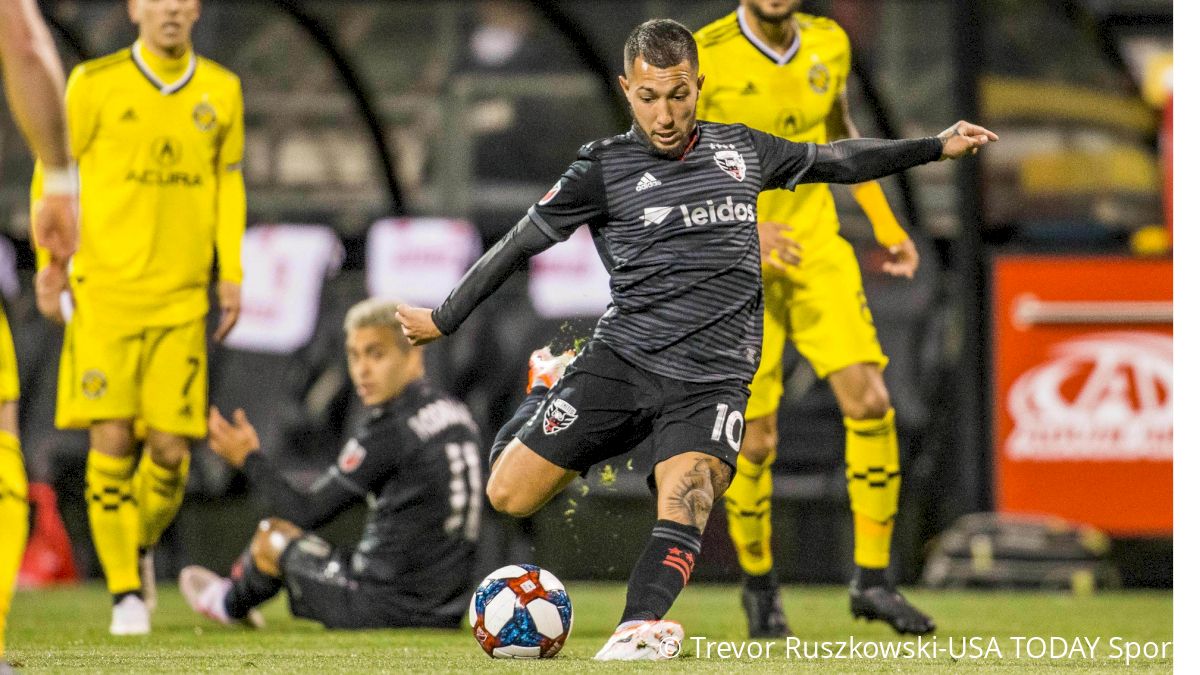
D.C. United got off to a great start in 2019, winning three of their first four games, scoring nine goals, and conceding just once. But in the month of April, the Black-and-Red found the road tougher, as Ben Olsen’s side won two of six games while scoring just four goals. Injuries have played their part, forcing the head coach to shuffle formations and slide players in and out of unusual positions. United are still top of the Eastern Conference, but when they had a chance of putting some space between themselves and a middling pack, United just couldn’t do so.
The biggest issue at the moment seems to be in front of goal for United. Wayne Rooney is doing his part with five goals and three assists. But Luciano Acosta hasn’t hit the same heights this year, with just two goals and two assists through the first 10 games. Lucas Rodriguez has had some bright moments but hasn’t been able to consistently produce for United.
So our question this week is what has contributed most to D.C.’s offensive woes? Is there a fix in the near future for the Black-and-Red?
Steven: D.C. United’s injuries at outside back have had a knock-on effect throughout the team. Not only has the team had to deal with the recent absences of Joseph Mora, Leonardo Jara, and Chris McCann, but because of those injuries, United have had to adapt their formation, and have played several players out of position as a result.
The addition of another center back has been that the Black-and-Red have been sound defensively, but within the new formation, one of their attacking midfielders has ended up playing as a wing back. The overall position on the field isn’t too drastic from wing back to wide attacking midfielder, but having to use either Paul Arriola or Lucas Rodriguez in the role has had adverse consequences.
Arriola, in particular, has a weapon that none of his teammates in attack possess — the speed that can help him race past back lines and into open space. Of course, that speed doesn’t go away when he plays as a wingback, but in that role he is starting further back on the field, which mitigates some of the effectiveness of his runs.
Rodriguez is a very different player than Arriola, but the idea remains the same: Moving the Argentine playmaker further away from goal, like Olsen did against the Columbus Crew, limits his ability to help United offensively. Rodriguez did a good enough job at the left wingback role against the Crew, as United won 1-0 on the road.
But getting a healthy set of outside backs healthy in important to United. That will allow Olsen to revert back to his preferred 4-2-3-1 formation, allowing the attacking midfielders to play as attacking midfielders, which should open up United’s attack.
Hunter: The easy answer: injuries.
The annoying answer: a mixture of things.
The evasive-but-I-think-it’s-a-decent-point-answer: I feel like the talk surrounding D.C. United’s offensive struggles has mostly centered around recent struggles, and it’s pretty apparent as to why that’s the case: In six games through the month of April, Olsen’s side managed just one match with more than a single goal — against the lowly Colorado Rapids. In three other games United didn’t score at all, and they squeaked just one past the Crew in Columbus.
But United’s offensive struggles have existed, I’d argue, all year long — dating back even to the preseason. The one game in which they’ve totally set all the fireworks ablaze was the March 16 game against an extremely volatile Real Salt Lake side that had two players sent off. But even in the preseason against the likes of the Tampa Bay Rowdies, Bethlehem Steel, FC Cincinnati, and Philadelphia Union, D.C. weren’t singing the back of the net.
To get to the actual question, though, I do think it’s been a mixture of things (annoying answer) — injuries certainly have played a significant part (easy answer), as D.C.’s promising fullback situation has been particularly decimated. The absence of Russell Canouse hasn’t helped anything, especially connecting the lines; moving Paul Arriola around, the formational changes, the actual busyness of the schedule hitting . . . there are millions of variables.
Here’s one bit of good news, though, for Olsen and United: The Black-and-Red haven’t played great offensively, but they’ve still been earning points. And they’ve been earning many of those points on the road. The hallmark of so many great teams — I think, for example, of Juventus — is the ability to not play super well but still manage the victories.
In other words, this team has time to figure things out. Not an infinite amount of time, and it’s not going to be easy, but I don’t think anybody in D.C. should be hitting the panic button at this point.
Wesley: Formation changes are always going to make finding consistency a tall order. I’d say United have done just about as well as they could have given the setbacks and players shifting to other positions. You can’t argue with first place in the standings, and would Donovan Pines have emerged so early in the season if not for the injuries suffered by outside backs? We’ll never know. However, as Hunter noted, the lack of production up front was apparent earlier in the year.
It may seem unfair to put a healthy portion of the blame on Acosta, but when you produce double digits in goals and assists and nearly sign with French giants PSG, that sort of pressure should be expected. I’m not sure if his head is elsewhere given the links to European clubs and ongoing contract talks with D.C., but we’re just not seeing the same type of confident, creative play from the Argentine.
I also want to see more out of Lucas Rodriguez. He has shown flashes and can prove to be an integral part of D.C.’s attack down the stretch, particularly if Acosta departs over the summer, but so far he hasn’t quite been able to replicate what Yamil Asad provided in last year’s squad. Asad’s ability to stretch back lines was crucial for opening up space for Rooney and Acosta to flourish. That level of pressure-relieving play might just be what’s missing and affecting the current goal count the most. Arriola settling back into his more advanced role can be the spark that really gets the side going in the month of May.