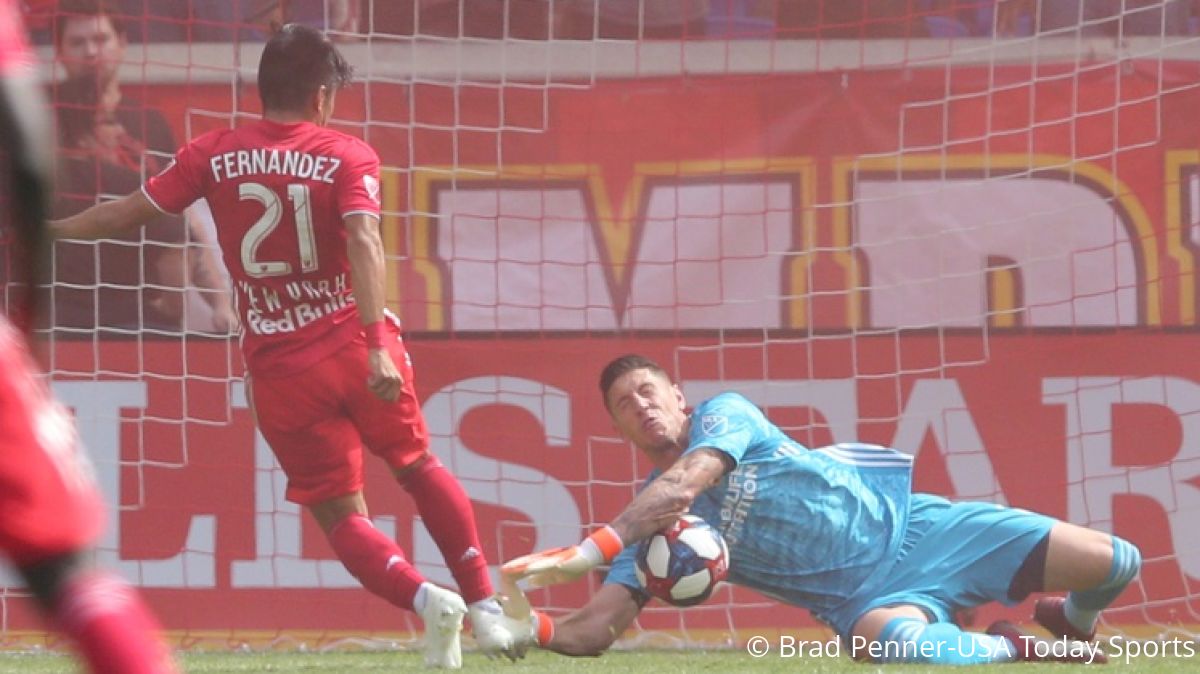
An active MLS Week 10 has concluded with Atlanta United blitzing Sporting KC in Kansas City. Let’s take a look at some notable things, including the Red Bulls, Earthquakes, and then a little more Red Bulls at the end.
What to make of the Red Bulls?
The New York Red Bulls teetered between three versions of themselves on Saturday. They started with induced chaos, sprinting everywhere and making every LA Galaxy player uncomfortable. They tired, the Galaxy figured out how to make themselves comfortable, and the Red Bulls withered on defense. Later in the game, when they fell behind by a goal, they poured numbers forward, dominating play and scoring twice to win 3-2.
For a team that has struggled to start the season, it ended up as a promising win. Before Saturday, the Red Bulls had muddled along as an average to below average team: They had taken eight points from eight games and held a goal differential of zero. Maybe now they will go back to being elite.
But the metamorphosis they produced in that wacky win against LA does not inspire confidence that this is a team with the stable, defined identity that has made opponents uncomfortable for a half-decade-plus. They pressed effectively for years, and then emphasized possession with last year’s midseason managerial change to Chris Armas. They won another Supporters’ Shield doing that.
It’s rare to see the Red Bulls sputtering for this long, or playing with the uncertainty they’re dealing with now. The defensive mistakes — of which there have been too many, inexplicably so for a team with Aaron Long, Tim Parker, and Luis Robles — symbolize the pervading tactical confusion.
They’ve won two straight now with a return of the three-at-the-back, which fits the all-out press they employed against LA. Jesse Marsch came up with that formation (call it a 3-2-2-2-1) last year when the 4-2-3-1 was struggling, and Armas has revived it as his own 4-2-3-1 struggles.
That wacky three-at-the-back puts players everywhere and emphasizes flexibility. The fullbacks range up and down the flanks. The lack of real wingers reduces the pressure placed on Sean Davis and Marc Rzatkowski in midfield.
It will be fascinating to see if Armas keeps that press up, or if he will save that for when it makes sense against a good team. (Keep an eye out for it in two weeks against Atlanta United.) If he trusts it, he has to eradicate the defensive fragility that could come with it. The Galaxy started to play through the press in the last 25 minutes of the first half, and found success challenging the backline, as other teams have this season. The midfield looks delicate when faced with combination play and passing.
Until they sign an elite attacker, the Red Bulls might not have the offensive firepower to keep the ball the way Armas wanted to last season. If it is a one or the other stylistic decision, pressing seems like the way to go.
Nothing is certain for a team that thrives on stability. Even in that win against the Galaxy, in which they looked as good as they have all season at times, they lost the xG battle handily. They will continue to search for an identity.
The San Jose Earthquakes, a competent team
With a 1-0 win over FC Cincinnati, the Quakes have suddenly gained a result in five of their last six games and sit seventh in the Western Conference. They’ve done it, as you’ve probably heard by now, with a man-marking system and a whole lot of stamina.
Against Cincy, they wanted to play on the ball and dictate the pace of the game. They did it in the first half, keeping 73 percent of the ball. But early in the second half, Cristian Espinoza took a bad second yellow and the Quakes were tasked with defending a 1-0 lead with 10 men for 40 minutes.
FCC decided not to really attack, weirdly subbing off striker Darren Mattocks and attempting to generate shots by starting a bunch of defensive midfielders out of position. The visitors ended up not creating many chances (surprise!) outside of a set-piece header that forced a big save out of Daniel Vega. Cincy have now scored exactly one goal since March 24, which is pretty insane.
San Jose will take the win, though. It’s a shame we were robbed of seeing what they could do for a full 90 against weak opposition.
Their man-marking system is a welcome tactical wrench. It requires a remarkable amount of fitness, but the Quakes seem to have that fitness, and Matias Almeyda is a good enough coach to implement it effectively.
Some flaws have shown through. They focus so much on marking a man that they tend to give up some space in midfield, trusting they can defend well enough around the box to offset it.
Flaw of the Quakes' man-mark system: Late arrivers and smart movement capitalize on the space they concede to mark specific players pic.twitter.com/bITCACU3yQ
— Harrison Hamm (@harrisonhamm21) May 5, 2019
That was with 10 men, of course, but the point remains. San Jose inherently give up space in midfield when they man-mark so heavily.
It will be interesting to see how they adapt as teams attempt to break it down. Cincy, even against 10 men, couldn’t really do it. Tougher competition looms.
Angelo Rodriguez, making plays
I have been skeptical of Angelo Rodriguez’s viability as a DP for Minnesota United since they signed him last year. He did not appear to do anything particularly well, and he does not put up astronomical scoring numbers.
But he has taken over as Minnesota’s starting striker and is playing well as an attacking fulcrum. He’s eased the burden of others around him as Darwin Quintero has missed time recently; Rodriguez can bust out of pressure on the ball with physicality and just enough on-ball skill. He finds the right passes.
His vision connects Minnesota’s attack:
Rodriguez is quietly an important attacking piece for the Loons.
Rebound control
Two MLS keepers struggled to keep their rebounds in check this weekend. Most egregious was Cody Cropper, whose New England Revolution let up six as they utterly capitulated in Philadelphia. Cropper did not shower himself in glory on a few of those goals and had a couple other instances during the game in which he failed to prevent the ball from leaking into a good area.
Just go ahead and watch the whole game highlight video. It’s worth it overall.
Cropper was far from the Revs’ only issue against the Union (their performance in the last 30 minutes was historically ugly), but he would have helped them a lot if he were able to rein in a couple of those. To do that, he has to recognize as a shot careens toward him that his goal is to either catch the ball or parry it in a non-threatening spot. He has to make a decisive decision early as to what he’s going to do with his save, and then have the body control to execute it. It takes quick thinking.
The reliable Tim Melia had an outright howler to give Atlanta United their lead on Sunday:
JOSEF MARTINEZ puts it all on the line and puts @ATLUTD ahead 1-0. #SKCvATL https://t.co/dhClNMvL6R
— Major League Soccer (@MLS) May 6, 2019
That one is more obviously bad than anything Cropper produced, but the same principles are at play. Control your rebounds, keepers!
Doing stuff on set pieces
For the final Little Thing of the week, we’ll circle back to the Red Bulls. Take a look at their first goal against the Galaxy, and how well-designed this free kick setup was:
AMRO TAREK!@NewYorkRedBulls love their set pieces. 1-0. #RBNYvLA https://t.co/nzkPMderBs
— Major League Soccer (@MLS) May 4, 2019
This wasn’t an incredibly elaborate play as the Red Bulls have done before, but it was a play nonetheless, and it created a goal on a free kick from distance. They simply had Brian White drag Zlatan Ibrahimovic out to where the cross would arrive to then allow Amro Tarek to slip in front of his mark and find the ball once it skipped past White and Ibrahimovic.
It was a bit messy in the end, with the ball bouncing initially off a Galaxy player, but Tarek found and scored it. Too many teams let these opportunities pass.
Harrison Hamm is a sportswriter who covers American soccer and MLS for FloFC. He also covers sports for FanSided and The Comeback, and has freelanced for the Washington Post.